Hardwood Flooring Nailer:
Floor Nailers that make Installation
a charm!
A hardwood flooring nailer really does make the installation
of a wood floor do-able for the average home renovator. With
the right power
nailer, floor installation is faster, tighter and more
secure.
The flooring nailer provides the following benefits:
 installs
the flooring cleat in the floor nailer and thus the floor,
at the right angle so that it seats itself correctly in
the tongue of the hardwood flooring. Most hardwood flooring,
on the tongue side is designed with a small notch just above
the tongue. Look at it closely and you'll see what I mean.
It is designed so that the head of the flooring nails seat
themselves in this notch... that allows abutting planks
of hardwood flooring to seat tightly against each other,
without the nail interfering. installs
the flooring cleat in the floor nailer and thus the floor,
at the right angle so that it seats itself correctly in
the tongue of the hardwood flooring. Most hardwood flooring,
on the tongue side is designed with a small notch just above
the tongue. Look at it closely and you'll see what I mean.
It is designed so that the head of the flooring nails seat
themselves in this notch... that allows abutting planks
of hardwood flooring to seat tightly against each other,
without the nail interfering.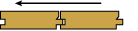 The
impact of the floor nail guns, either the manual nailer
or the pneumatic floor nailer, is designed in such a way
to not only drive the cleat into the wood and the subfloor
below, but also to drive one plank of hardwood flooring
tightly against its neighbour. With a well made hardwood
floor, ie. straight boards, and accurate tongue and groove,
this side impact of your floor nailer will eliminate the
need to use a crow bar to flush fit individual boards in
most cases. The
impact of the floor nail guns, either the manual nailer
or the pneumatic floor nailer, is designed in such a way
to not only drive the cleat into the wood and the subfloor
below, but also to drive one plank of hardwood flooring
tightly against its neighbour. With a well made hardwood
floor, ie. straight boards, and accurate tongue and groove,
this side impact of your floor nailer will eliminate the
need to use a crow bar to flush fit individual boards in
most cases.- A wood flooring nailer also drives the cleats
into the floor at a speed and direction that "most
of the time" prevents tongue damage. I have had customers
that have attempted to pre-drill and hand nail an entire
room of hardwood flooring. Not only did it take them a long
time, but quite often they have come back with horror stories
on how many boards that had to removed because the hammer,
either split the tongue or hit the good face of the floor.
Nail guns do eliminate most of this damage.
- Nail guns also allow you to use a special type of cleat
or staple. Hardwood
floor nails are typically dipped in a type of resin
that strengthens the holding power of the nail to stay tight
into the sub floor. This helps to prevent squeaking, caused
by ineffective nailing between the hardwood floor and the
subfloor.
There are two different types of floor nailers:
- Manual Nailers... the nail is entirely driven into the
wood with bruit force. Some old timers believe this is necessary
to make sure every board connects tightly with its partner.
For the novice they require some practice.
- Pneumatic
Floor Nailer.. the nailer is attached to a compressor
and the air pressure plus you hitting the driver head, inserts
the nail. They do require less experience but are a little
more cumbersome as you must address dragging around a hose
line.
Well I hope I have managed to convince you of all the advantages
of using a proper hardwood flooring nailer. I know that around
my area the costs to rent is approximately $30-40 /day. It
is well worth the money. It provides you with peace of mind
that your floor will be nailed securely and gets you up off
your knees much faster!
Happy woodworking... K

|
|